
At Legacy Fence Company, cedar fence installation is the predominant service request in Central Austin, and the reason is straightforward. The established neighborhoods of Hyde Park, Allandale, Rosedale, Brentwood, and Bryker Woods have a residential character built on decades of cedar privacy fencing. The material fits the landscape, fits the architecture, and fits the expectations of the neighborhood associations and historic overlay guidelines that govern some of these areas. When a Central Austin homeowner needs a new fence, cedar board-on-board is almost always the right starting point.
The Central Austin homeowners we work with in Hyde Park, Allandale, and Rosedale are often replacing aging cedar that was installed in a previous decade and has reached the end of its service life. Understanding what goes into a quality cedar installation in this specific part of Austin, where mature trees, grade changes, and older lot conditions are the norm, helps homeowners make better decisions about their project.
Here is what cedar fence installation looks like in Central Austin specifically.
Why Cedar Fits Central Austin’s Established Neighborhoods
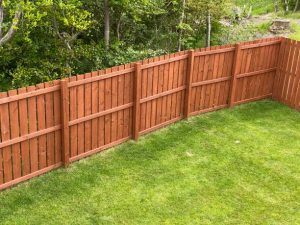
Cedar board-on-board privacy fencing is the visual language of Central Austin’s residential blocks. Drive through Hyde Park, Allandale, or Rosedale and you see the same material repeated throughout: the warm brown tones of stained cedar, the slight texture of the wood grain, the familiar pattern of overlapping vertical boards. This consistency is not accidental. Cedar became the standard in these neighborhoods because it suits the mid-century architectural character and the mature natural landscape in a way that vinyl or chain link does not.
The older neighborhood associations in Central Austin, while not always formal HOAs with binding approval processes, tend to have strong community opinions about fence materials and styles. Cedar is universally appropriate in these contexts. Vinyl is generally accepted but sometimes viewed as a departure from neighborhood character. Composite is becoming more accepted as awareness grows but still faces occasional resistance in the most established neighborhoods. Cedar remains the lowest-friction material choice for any Central Austin homeowner who wants a fence that fits the neighborhood without requiring additional community discussion.
Our wood fence installation service covers cedar in all configurations appropriate for Central Austin, from traditional board-on-board to the less common horizontal cedar that occasionally appears on newer construction within the neighborhood. We source appropriate grade cedar for Central Austin projects and factor the site-specific conditions of each property into the installation approach.
Cedar Grade and Material Considerations in Central Austin
The cedar grade used for fence boards has a meaningful impact on how the fence looks and holds up over time. Number 2 or better cedar excludes boards with large loose knots that will fall out within the first few years, leaving holes in the fence surface. It also excludes boards with weak grain patterns that crack and split prematurely in Austin’s heat and UV exposure. For a Central Austin cedar fence that will be visible from both sides and maintained as part of an established neighborhood streetscape, board grade matters more than it does in a utilitarian backyard application.
Posts are a separate material consideration. Fence posts should be pressure-treated pine or cedar rated for ground contact, not standard dimensional lumber. In Central Austin clay soil, untreated posts in ground contact rot at the base significantly faster than treated posts. This is the most common cause of premature fence failure in Central Austin: the original installation used inadequate post material, and the posts rot at the ground line before the fence boards have lived out their useful life.
Our guide on how long a wood fence lasts in Austin covers how cedar grade and post material selection affect fence longevity in Austin’s climate. For Central Austin homeowners replacing a fence that failed prematurely, the guide provides useful context for understanding what went wrong in the previous installation and how to avoid the same outcome.
Cedar Staining in Central Austin: Shaded Lots and Mixed Exposure

Central Austin’s mature tree canopy creates a more complex staining environment than the fully exposed suburban lots of North Austin. Many Central Austin fence lines pass through zones of mixed sun and shade as they run along property boundaries. A fence that receives four hours of direct sun in the back corner of the yard may have sections under live oak canopy that receive only filtered light. The staining maintenance schedule should account for this variation.
The practical approach for Central Austin cedar fences with mixed exposure is to calibrate the staining cycle to the most exposed section. If the most sun-exposed part of the fence needs attention after two years, the entire fence gets stained on that cycle even if the shaded sections could go longer. Staining only the exposed sections and leaving the shaded sections is not practical for most homeowners, and maintaining a consistent staining schedule across the full fence produces a more uniform appearance and simpler maintenance rhythm.
Our fence staining service covers Central Austin cedar across the full range of shade and sun exposure conditions. We assess the current stain condition, the shade coverage, and the degree of gray oxidation during the estimate visit to recommend the right prep and staining product for your specific fence.
What Cedar Installation Looks Like on a Central Austin Property
Cedar fence installation on a typical Central Austin property starts with the site assessment at the estimate visit. We walk the planned fence line, mark the post locations, check for known root systems and underground utilities, assess the grade along the line, and note any conditions that will affect the installation approach. For Central Austin properties with mature trees, this assessment is particularly important because post adjustments identified early are much easier to handle than root conflicts discovered on installation day.
Once posts are set and concrete has cured, rails go on first, followed by cedar boards in the board-on-board pattern. Board-on-board installation involves alternating board placement on opposite faces of the rails to create the overlapping pattern. The top boards are cut to a consistent height, gates are hung last, and hardware is adjusted for function. The finished fence is walked with the homeowner before the crew leaves.
Request a free estimate for your Central Austin cedar fence project and we will assess your specific property conditions, confirm any overlay or permit requirements, and provide a complete written quote for the installation.