
At Legacy Fence Company, composite fence cost is one of the questions we get most often, and the answer is almost always more nuanced than homeowners expect. Composite fencing costs more upfront than cedar, and that single fact stops many people from considering it further. But the upfront comparison alone does not tell the whole cost story. When the full ten to fifteen year cost is accounted for, including cedar staining cycles, board replacements, and earlier full replacement, composite often reaches cost parity with cedar or comes out ahead.
Composite fence pricing across the greater Austin area, is influenced by a set of local factors that do not appear in national cost estimates. Austin’s clay soil requires deeper post setting than in many other markets. The city’s HOA landscape can add material requirements. And the terrain variation across Austin’s neighborhoods, from flat North Austin subdivisions to hilly West and South Austin lots, affects labor scope significantly.
This guide breaks down what drives composite fence pricing in Austin, how it compares to cedar and vinyl over time, and what Austin-specific factors affect the final number on your estimate.
What Goes Into the Cost of Composite Fencing in Austin
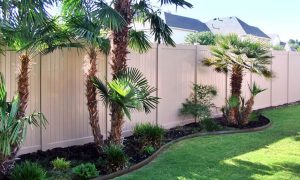
The composite material itself is the first cost driver, and the range is significant. Composite fencing comes in entry-level, mid-range, and premium product tiers, and the price difference between them is substantial. Entry-level composite has more wood fiber content and less plastic, which reduces cost but also reduces UV resistance and moisture protection. Premium composite has better UV stabilization, tighter tolerances, and longer manufacturer warranties. The product tier you select has a direct effect on both the upfront cost and the long-term performance. Choosing the cheapest composite available in Austin’s climate often means the gap between composite and cedar performance closes faster than expected.
Linear footage is the most straightforward cost driver. The more linear feet of fence you are installing, the higher the total material and labor cost. However, cost per linear foot typically decreases on larger projects because some fixed costs are spread across more fence. Post depth in Austin adds a real local premium. Our clay soil requires posts to go deeper than in many other markets, which means more concrete per post and more labor per post.
Gate additions, terrain complexity, and existing fence removal are the other significant variables. A gate adds material and hardware costs on top of the fence line rate. Sloped lots require stepped or racked construction, which adds labor. Removing and disposing of an old fence before the new one goes in adds scope that should appear as a separate line item in any complete estimate.
Composite vs Cedar vs Vinyl: The Real Cost Comparison in Austin
Cedar has a lower upfront installation cost than composite in most Austin configurations. That cost advantage is real but it is not the full picture. A cedar fence in Austin requires staining or sealing every two to four years depending on sun exposure. Each staining cycle has a cost, whether you hire it out or do it yourself in time and materials. Over ten years, those maintenance costs accumulate. Cedar boards also crack, warp, and rot over time, particularly in the high-UV south and west-facing fence lines common in Austin. Board replacements add further cost.
Our guide on the pros and cons of composite fencing for Texas homes covers the full cost-of-ownership comparison between composite, cedar, and vinyl in detail. The most honest comparison accounts for total expected cost over the full life of the fence, not just the installation day number.
Vinyl sits between cedar and composite on the upfront cost spectrum in most Austin configurations. It requires no staining and holds up well in Austin’s climate. The trade-off is aesthetic. Vinyl has a more manufactured appearance than composite or cedar at close range. For homeowners who prioritize the natural wood look but want low maintenance, composite is the closer match.
How to Get an Accurate Composite Fence Quote in Austin

The most important thing to know about composite fence pricing is that an accurate quote requires a site visit. The variables that affect cost on your specific property, including soil conditions, fence line length and terrain, HOA requirements, gate specifications, and existing fence disposal, cannot be assessed accurately from a satellite view or a phone call. Any per-linear-foot estimate given without a site visit is based on assumptions that may not match your actual project.
Our guide on how much fence installation costs in Austin explains what a complete, itemized estimate should include and how to evaluate what you receive from any contractor. Understanding the line items before you sign is the most important step in getting the right project at the right price.
Request a free fence estimate and a local crew will visit your property, assess all the relevant variables, and provide a written, itemized quote that reflects your actual project.