
At Legacy Fence Company, horizontal cedar fence installation has become one of our most frequently requested styles in East Austin over the past several years. The shift from traditional vertical board-on-board to horizontal cedar tracks directly with the wave of contemporary infill construction that has reshaped much of East Austin, and the style is now as common on new construction in this part of the city as board-on-board was on the original residential stock. Understanding what makes horizontal fencing different, where it fits well, and what the installation involves helps homeowners make better decisions about whether it is the right choice for their property.
Across properties throughout Austin TX, horizontal fencing requests come disproportionately from East Austin, Mueller, and Central East Austin, where the contemporary architectural character of infill development has driven demand for fence styles that match it. This guide covers what makes horizontal cedar distinctive, how it compares to board-on-board in practical terms, and what to expect from the installation.
Here is the honest picture of horizontal fence installation in East Austin.
What Horizontal Fencing Is and Why It Works in East Austin

Horizontal fence installation runs the fence boards in a parallel horizontal pattern across the fence frame rather than in the traditional vertical orientation. The boards are attached to posts and vertical framing members rather than horizontal rails, and the visual result is a fence that reads as a series of clean parallel lines rather than a solid vertical panel. When boards are installed without gaps, horizontal fencing provides the same full privacy coverage as board-on-board. When installed with slight gaps between boards, it creates a semi-privacy effect that allows air flow while still blocking most views through the fence.
The contemporary aesthetic of horizontal fencing matches the architectural language of the modern infill construction that has come to define large portions of East Austin. A horizontal cedar fence sits visually alongside a flat-roofed 2022 infill townhome in a way that a traditional board-on-board fence does not. This aesthetic coherence is the primary reason horizontal cedar has become the dominant style request on new construction in this part of Austin. On the original housing stock, board-on-board remains appropriate because it fits the mid-century residential character.
Our wood fence installation service covers horizontal cedar fencing alongside all other cedar configurations. We install horizontal fencing throughout East Austin, Mueller, Cherrywood, and the infill development areas of Central East Austin where it has become the standard contemporary style.
Structural Considerations for Horizontal Cedar Fencing
Horizontal boards have a natural sag tendency that vertical boards do not. When a fence board is oriented vertically, gravity pulls it straight down against the fasteners. When a board is oriented horizontally, gravity pulls it away from the fence plane and toward sag along its length. The framing system that supports horizontal boards must account for this force.
Properly built horizontal fencing uses vertical support members spaced closely enough to prevent sag along board lengths. The spacing depends on the board species, grade, and thickness. Horizontal fence installations that use framing designed for vertical boards will eventually develop noticeable sag in the horizontal runs, particularly on longer spans. We size the framing for every horizontal cedar installation based on the board dimensions and the span lengths involved.
Board grade is also more visually significant in horizontal fencing than in board-on-board. Horizontal boards are viewed along their full length at a consistent angle, which makes any grain inconsistency, large knot, or warping more noticeable. Number 2 or better cedar is the minimum appropriate grade for horizontal cedar fencing in East Austin. Clear cedar is worth considering for homeowners who want the cleanest possible appearance on high-visibility fence sections.
Comparing Horizontal Cedar to Board-on-Board in East Austin
Board-on-board cedar is the proven standard in Austin with decades of documented performance in this climate. It is the most forgiving installation style because minor variations in board width, fastener placement, and post spacing are absorbed by the overlapping board pattern. It is also the most widely accepted style in Austin HOA communities and the most recognized as an appropriate fence style for Austin residential properties across all housing eras.
Horizontal cedar offers a contemporary aesthetic advantage on properties where the architecture calls for it. The cost premium over board-on-board is real but modest. The maintenance requirements are identical. The structural framing demands are higher, which is why installation quality matters more for horizontal fencing than for board-on-board. A horizontal fence installed with inadequate framing will develop visible sag within a few years. A horizontal fence built with appropriate framing holds its appearance for the full life of the cedar.
Our guide on what type of fence is best for Texas weather compares all the major fence materials and styles in Austin’s climate. Our guide on fence types available in Austin gives a full overview of the style options across both wood and non-wood materials. For East Austin homeowners who want to see horizontal cedar in the context of their specific lot and architectural style, the estimate visit is the most useful starting point.
What Horizontal Fence Installation Looks Like in East Austin
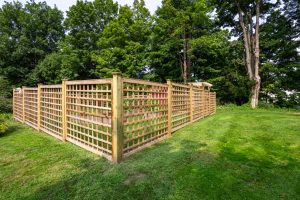
Horizontal cedar fence installation follows the same fundamental process as any wood fence project. Post setting in Austin clay soil requires the same depth and concrete specifications as board-on-board installation. The difference is in the fence panel construction. Instead of horizontal rails with vertical boards, horizontal fencing uses vertical framing members with horizontal boards. The framing members are set at appropriate spacing intervals, the horizontal cedar boards are fastened to them in sequence from bottom to top, and any gaps or tight spacing is set consistently across the fence panel.
Gate installation on horizontal cedar fences deserves specific attention. A horizontal cedar gate matches the fence panel aesthetic and requires a properly engineered gate frame to prevent the horizontal boards from racking the gate out of square over time. The gate frame needs internal diagonal bracing to maintain its shape, and the hinge and latch hardware needs to be sized for the gate weight and expected usage. We build horizontal cedar gates with appropriate internal bracing on every project.
East Austin’s alley-access lots sometimes need a rear gate that matches or coordinates with the horizontal cedar on the rest of the fence line. We handle alley gate installations as part of the full fence project or as standalone additions to existing fences. Request a free estimate and we will assess your East Austin property, discuss the horizontal fencing options for your specific lot, and provide a written quote.