
At Legacy Fence Company, wood fence installation is the most commonly requested service we provide in Austin. Cedar privacy fencing has been the standard in this city for decades, and it continues to dominate because it fits the climate, the architecture, and the HOA requirements of most Austin neighborhoods. But not all wood fence installations are the same, and understanding the style options, material grades, and installation approach before you hire a contractor produces significantly better results.
The wood fence installations we handle across Austin TX cover a wide range of styles and property types, from traditional board-on-board privacy fencing in established North and South Austin neighborhoods to contemporary horizontal cedar on new construction infill in East Austin. This guide walks through everything that affects the quality and longevity of a wood fence in Austin.
Here is what to know before you get a single estimate.
Wood Fence Styles Available in Austin

Board-on-board privacy fencing is the dominant style in Austin residential neighborhoods and the configuration most homeowners picture when they think of a cedar privacy fence. Boards are attached to horizontal rails in an alternating overlap pattern that provides full privacy coverage with no gaps. The overlapping pattern also adds structural rigidity to the fence surface. This style is accepted by the vast majority of Austin HOAs that permit wood fencing and works on virtually every residential property type.
Horizontal cedar fencing has grown significantly in popularity over the past several years, driven largely by the contemporary aesthetic it creates on newer construction and infill properties in East Austin, Mueller, and Central East Austin neighborhoods. Instead of vertical boards, horizontal cedar runs the boards in a parallel horizontal pattern across the fence frame. The look is cleaner and more modern than traditional board-on-board. Horizontal fencing requires more substantial framing to prevent the boards from sagging over time, and it is worth confirming HOA acceptance before committing to this style.
Shadowbox fencing alternates boards on opposite sides of the rails, producing a fence that has no gaps but allows some air flow and has a finished appearance on both sides. Picket fencing uses spaced vertical boards and is more appropriate for front yard definition than privacy applications. Dog-ear fencing is a simple vertical board style with notched top corners that is one of the most affordable cedar fence configurations available. Our wood fence installation service covers all of these styles.
Cedar vs Pine: The Right Wood for Austin
Cedar is the correct choice for Austin fence boards in almost every situation. Western red cedar and eastern red cedar both have natural oils that resist moisture absorption and insect damage without chemical treatment. In Austin’s alternating wet-dry seasons and high-UV environment, untreated cedar holds up significantly better than untreated pine. Cedar also takes stain penetration better than most pine grades, which matters for maintenance.
Pressure-treated pine is sometimes proposed as a cost-saving alternative for fence boards. Treated pine has preservative chemicals forced into the wood fiber that provide rot and insect resistance, but the treatment does not replicate cedar’s natural performance in Austin’s UV environment. Treated pine fence boards tend to warp and crack in Austin heat more readily than cedar, and they do not accept stain as cleanly. The cost difference between cedar boards and treated pine boards is modest, and the performance difference in Austin’s conditions is meaningful enough to make cedar the consistently better investment.
Posts are a different matter. Fence posts should be pressure-treated pine or cedar specifically rated for ground contact, not standard dimensional lumber. Untreated posts set in Austin soil, whether clay or limestone, will rot at the ground line significantly faster than treated posts. Our guide on how long a wood fence lasts in Austin covers how post material and treatment affect fence longevity in this climate.
Wood Fence Installation in Austin Clay Soil
Austin’s black expansive clay soil is the single most important variable in wood fence post longevity. The clay swells when it absorbs moisture and contracts as it dries. This cycle exerts significant force on fence posts, particularly posts that were not set deeply enough to anchor below the active zone of soil movement. Posts set at minimum adequate depth in Austin clay will hold for years. Posts set shallower will begin to rock and lean after the first few wet-dry cycles.
The standard for Austin fence post depth is a minimum of one-third of the total post length plus six inches below grade. For a standard six-foot privacy fence using eight-foot posts, this means thirty to thirty-six inches of post in the ground. The concrete encapsulation around the post base should be thorough, extending above the original soil grade line slightly to prevent soil from trapping moisture against the post at the most vulnerable point. Our guide on what type of fence is best for Texas weather covers why installation quality affects wood fence longevity more than any single material choice.
After posts are set and concrete poured, the concrete needs to cure before rails and boards are attached. Attaching fence boards before the concrete has cured puts lateral load on fresh concrete that has not yet reached full strength. We pour posts on day one and return to attach rails and boards after the concrete has had adequate time to cure, which is typically overnight in Austin’s climate.
HOA and Permit Considerations for Wood Fencing in Austin
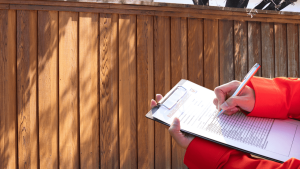
Cedar board-on-board privacy fencing is the most widely accepted fence style in Austin HOA communities. Most communities that have fence guidelines specify cedar as the approved material, and board-on-board is the default style. Horizontal cedar, shadowbox, and other style variations may require specific HOA approval even in communities where cedar wood is approved generally. We review HOA specifications for every wood fence project to confirm the proposed style and material meet the community requirements before installation begins.
Austin permits are required for fences over eight feet tall and in certain flood zones or overlay zones. Most standard residential privacy fences at six feet do not require a city permit. We check permit requirements for every project. If you are in a HOA community, the HOA approval process should be started before the permit process since HOA approval timelines can be longer and drive the overall project schedule.
Request a free wood fence estimate and we will walk your property, assess soil and terrain conditions, review your HOA requirements, and provide a written quote that covers material grade, post specifications, and the complete installation scope.